Shaggy past
August 10, 2026


The ’80s get flak for bizarre trends, although it’s not like there weren’t some doozies in the ’70s. Shag carpet meant not stepping on a cold bathroom floor, but c’mon, shag toilet seat covers, wastebasket covers, and on every surface? Crazy times 🤣
The bathroom shag went ages ago, and according to interior designers, there are plenty of other things that can go too. From mismatched towels to excess bath mats, the experts say you can get rid of these 11 things to keep your bathroom in style.
And leave the Shag to the OG ;)
(Love nostalgia? Play today’s trivia below!)
Good morning Staker! Here’s what’s cookin’ today: The economy shed 23,000 jobs last month; understanding the evolving conventional wisdom for managing your investments; understanding the differences between surveillance pricing and dynamic pricing; and say hello to an extremely rare crustacean… 🦞
Let’s get into it!
CONSUMER
Surveillance pricing vs. dynamic pricing

Unsplash
You’ve likely heard of both dynamic and surveillance pricing, but the idea that they’re fundamentally different things may be surprising.
For example, dynamic pricing has basically been around for as long as free markets. The name indicates that prices fluctuate based on market forces that alter the disconnect between supply and demand; when demand rises and supply doesn’t, prices go up; when demand falls and supply doesn’t, prices go down.
Surveillance pricing, however, is a little more insidious, as the name suggests. It’s not just about market forces, but about market forces in relation to an individual’s point of view. Technology is used to monitor the individual, bringing his or her behaviour and characteristics into the fold as market forces themselves.
Some like to use the term “personalized” instead of “surveillance” as a way of bypassing the negative connotations associated with what actually drives prices under this method of assessing value.
The reality is one has been driving price fluctuations since the advent of capitalism, albeit with greater precision today, aided by technology. The other fully relies on technology, and is considered invasive—possibly to an extralegal extent—by the majority of consumers.
SPACE
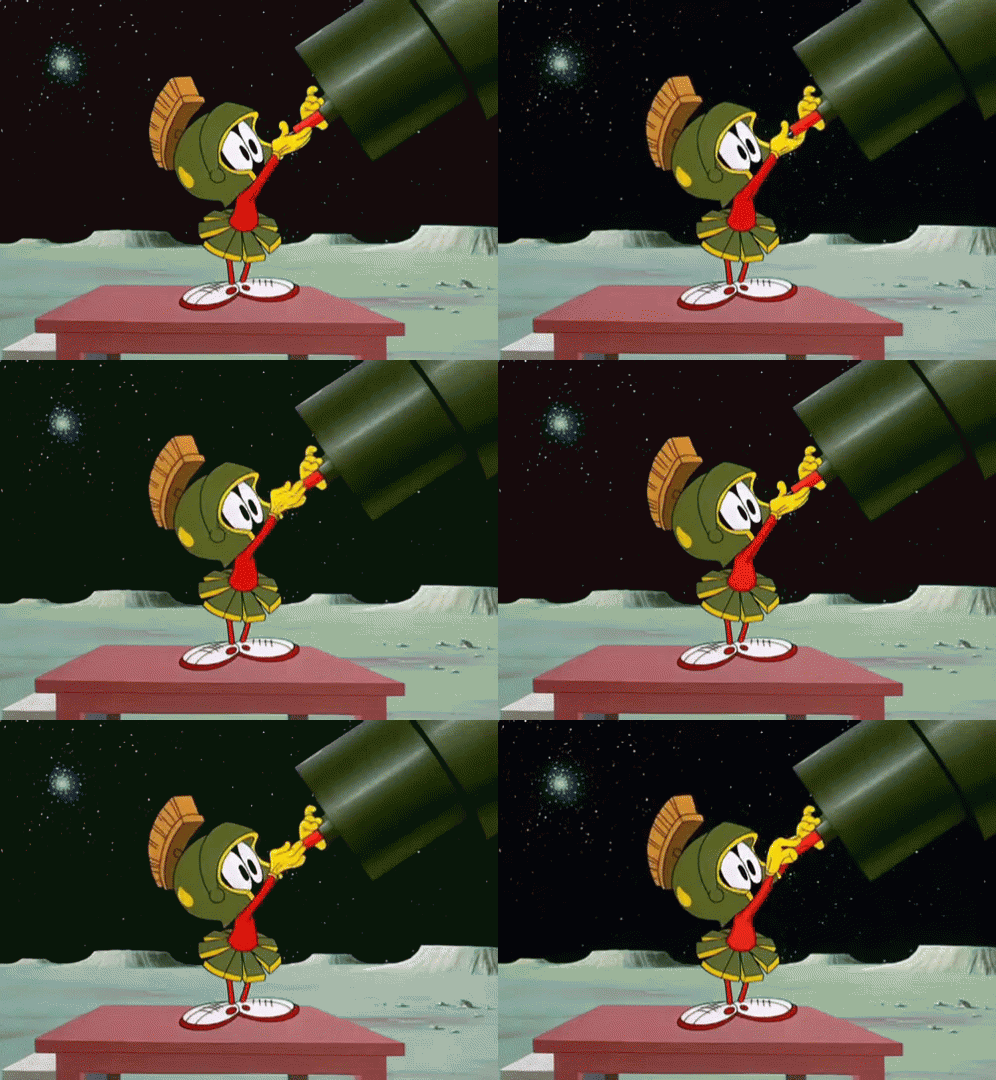
Scientists make rare real-time discovery of lunar impact crater
Giphy
In April, scientists at various space agencies determined a wayward Falcon 9 rocket was going to crash into the Moon at some point in August.
Though many expected to be able to see it happen in real time, the only tool thus far to have clearly captured before-and-after photos of the small blip left on the lunar surface is the Korean AeroSpace Agency’s Danuri lunar orbiter.
The rocket had a mass of about 8,000 pounds, and careened into the Moon last week at about 5,400 mph. It left an impact crater of about 100 feet in diameter, and created a plume of dust that expanded into a volume of dozens of square miles.
“This observation offers a valuable opportunity to conduct in-depth research on lunar surface changes and impact mechanisms,” KASA said in a statement.
The KASA orbiter was on a path around the Moon that allowed it to take photos on one pass before the rocket crashed, and photos of the resulting crater on the very next pass.
The plume was made of sodium and lithium, with the former likely derived from lunar surface dust and the latter from the rocket itself.
CURIOSITIES
Oscar is one in 50 million

CTV News
Oscar the multi-colored lobster was donated by a local fisherman to Dalhousie University’s Beaty Centre for Marine Biodiversity, and has been a stalwart of the facility in terms of his ability to attract visitors.
He’s so rare, he could probably even draw the attention of other lobsters. Only one in 50 million end up displaying the split-down-the-middle exterior visible in the photo above.
“It is very rare in the animal kingdom, and very rare in lobsters,” said John Batt, manager of the Halifax-based centre.
“They named him Oscar, because they think he deserves an Oscar for his award-winning looks,” said Nadia Stewart, the Beaty Centre’s visitor experience facilitator. “He is half-orange and half the normal lobster color, which is dark greenish, and his legs also have a tinge of blue in them.”
Lobsters end up like this when two unfertilized eggs make contact with one another, and one engulfs the other. When the resulting hybrid is fertilized, two sets of DNA are being fertilized, and in this case, those DNA codes contain separate color profiles.
Oscar could live for over 100 years, and given his special gifts, marine conservationists will surely be keeping an eye on him, even after he’s released back into the wild.
STAKE TRIVIA
Runnin’ free in ’83

Giphy
From the top of the box office to the top of the charts, we’re throwin’ it back to everything that was hot during this week in 1983, with today’s trivia! 😎
Have a great day ahead Staker!
Today’s issue written by Michael Cowan, Joey Cowan, and Maureen Norman.